









九号创新:光从头顶来,风也从头顶吹。所以迟早会有人问出那个理所当然的问题:为什么声音不能也从头顶来?这么多年了,吊顶风扇一直在默默给自己加戏——加个灯、配个遥控器,偶尔再搞点智能功能。但说实话,这些所谓的“灯扇一体”大多只是个礼貌的升级,大家对这种家电其实也没多大热情。直到 AirFi One 出现,工业设计新物种,用极简设计重塑空间体验,这才算是真正迈进了“客厅核心体验”的门槛。
@NINEIDEA九号创新 www.nineidea.com
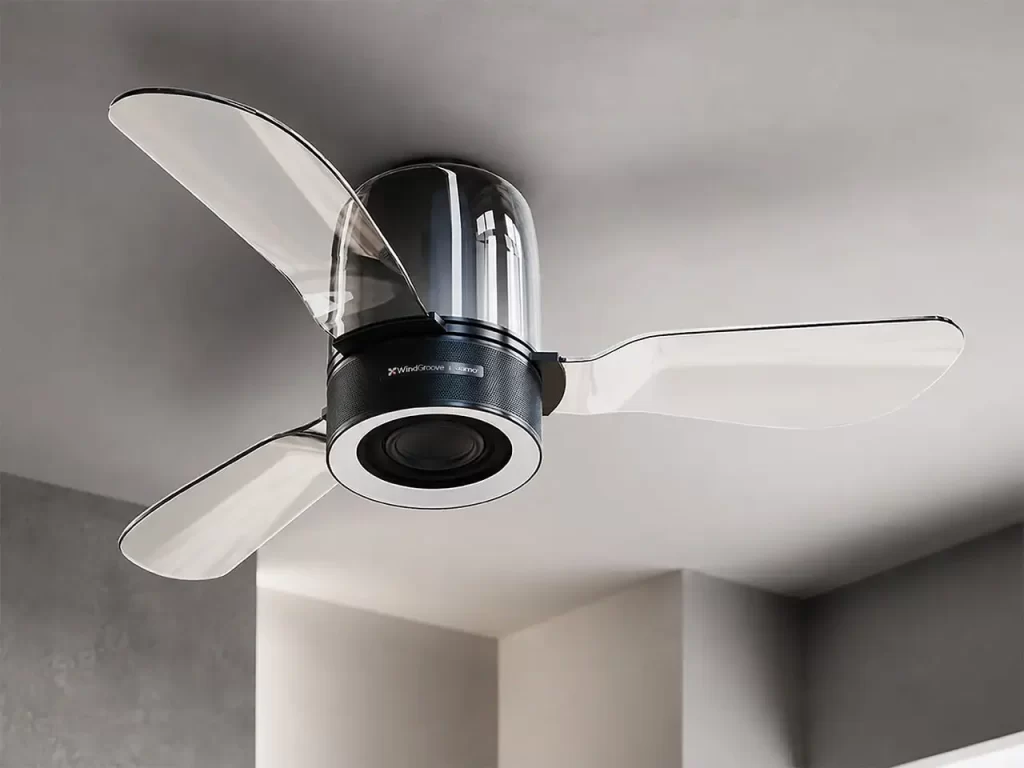
AirFi One 把 Hi-Fi 音响、氛围照明和空气循环系统,完美折叠进了一个吊顶 fixture(装置)里。最让我觉得靠谱的是,它的音频系统是跟丹麦老牌音响 Jamo(尊宝,创立于1968年)联合调校的。这一下就把产品的 credibility(可信度)拉满了,完全不是那种“啥都想干但啥都干不好”的噱头 gadget。
刚听到“吊顶风扇里塞音响”这个点子,你可能会觉得有点荒谬。但大概三秒钟后你就会反应过来:为了摆这些落地音箱和立式风扇,我们到底白白浪费了多少宝贵的地面空间?
品牌:WindGroove 原文作者:SARANG SHETH
️ 声学设计的“地狱级”难题
从声学设计的角度来看,把扬声器塞进一个旋转的机械系统里,简直是个“地狱级”难题。这在以前根本没人敢碰。为什么?因为电机会产生振动,振动顺着金属外壳和安装件一路传导,最后全让扬声器单元给吸收了。而且风扇转速一高,扇叶切割空气产生的周期性气压变化,会直接让振膜发抖,声音全是失真。
更要命的是,声音从头顶往下打,天花板就是个巨大的反射面,极易产生相位抵消和梳状滤波效应——有的频段互相叠加,有的频段直接抵消。能在一个变速旋转、还挂在人头顶的机械上,调出干净的 Hi-Fi 音质,这绝对是个令人佩服的工程壮举。
技术消融于空间的设计哲学
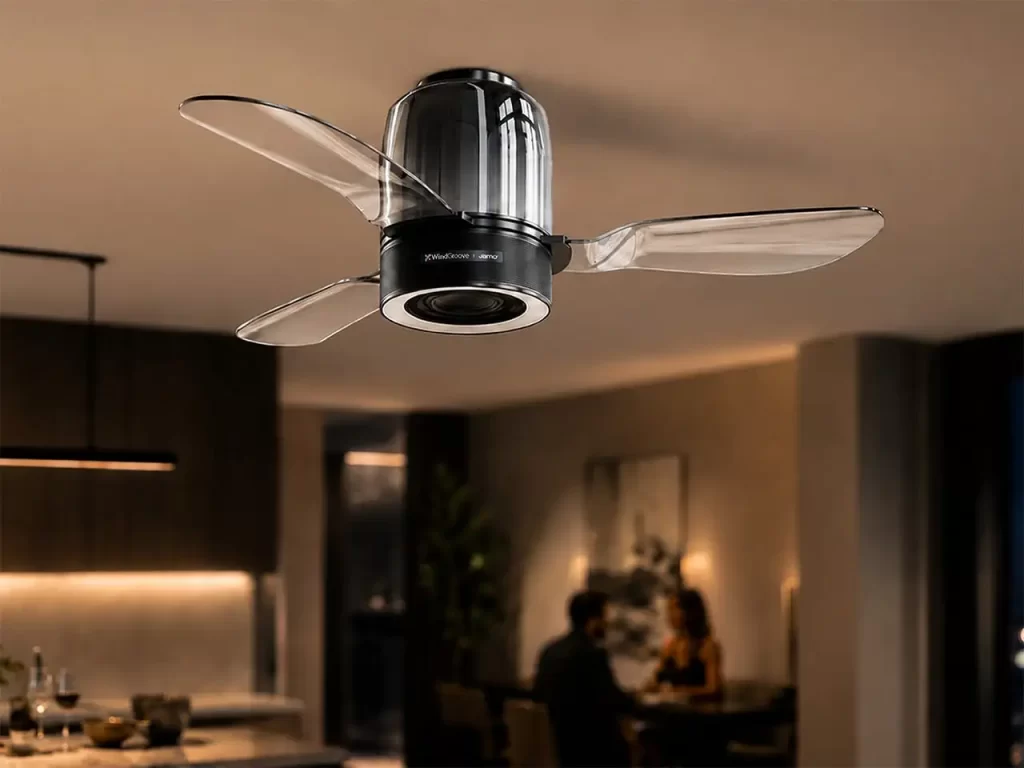
整个设计哲学就一句话:技术应该消融在空间里,而不是跳出来刷存在感。
为了实现这种“消融”,必须在工程上死磕。为了解决电机振动和扇叶气压脉冲的问题,他们上了一套非常聪明的 DSP(数字信号处理)算法,能实时修正天花板反射和头顶投射带来的声学缺陷。这是我觉得最优雅的一个解法——让扬声器在建筑里“隐身”,却依然能把声场填满。官方标称总谐波失真(THD)控制在 1% 以下,这意味着你听到的是纯粹的音乐,而不是硬件在痛苦地嘶吼。同时,他们把电机噪音压到了 32 分贝以下,直接从源头掐断了机械振动,这也给后期的 DSP 算法减轻了巨大的负担。
传承百年的声学调校
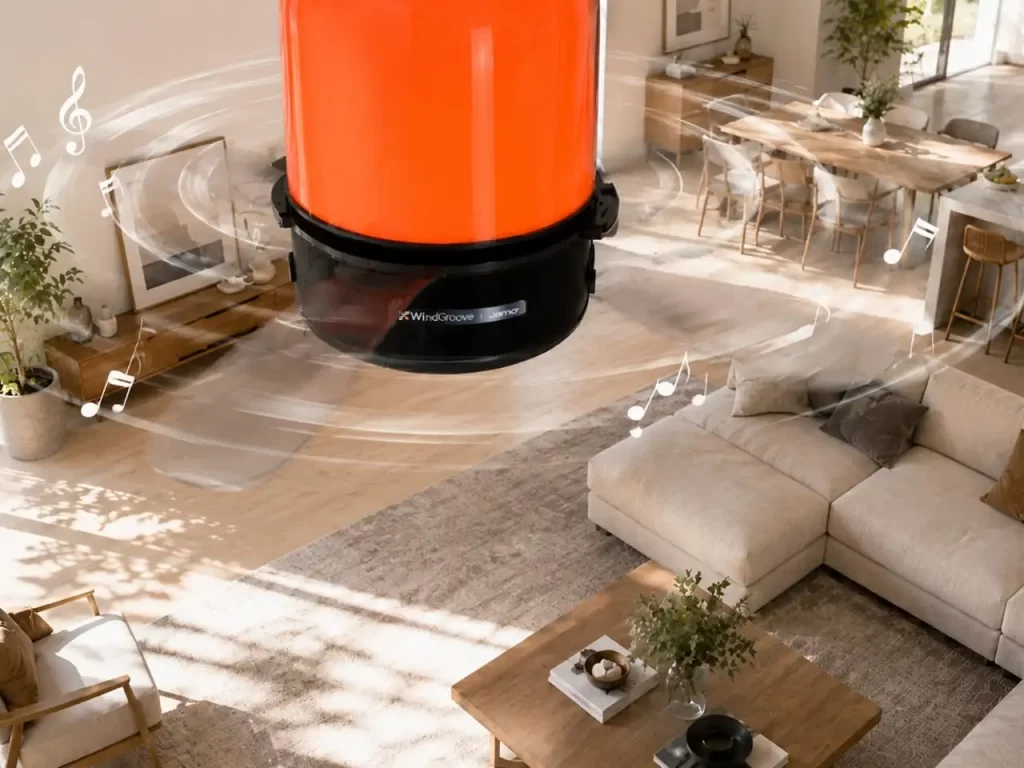
在调音上,WindGroove 显然借了 Jamo 的“魂”。Jamo 从 1968 年起就坚持斯堪的纳维亚式的声学平衡,AirFi One 也继承了这一点。这套 80W 的三分频系统(两个 15W 的中高音单元 + 一个 50W 的独立低音单元),是真的冲着 Hi-Fi 去的,而不是那种集成家电里常见的“听个响”妥协方案。频响范围做到了 45Hz-20kHz,低频有质感,高频够通透。愿意找这种有底蕴的音响品牌来调音,而不是随便堆个廉价喇叭,哪怕技术是隐形的,当你真正坐下来听的时候,它也必须保持最高水准。 把一套 Jamo 调校的 80W Hi-Fi 系统塞进风扇里,这个产品决策背后的逻辑是:空间优先,硬件自己想办法隐形。
️ 极致参数与沉浸式场景
再看看硬参数:最大风量 4621 CFM,噪音依然压在 32 分贝以下。这意味着你一边听歌一边开风扇,风声完全不会跟音乐打架。扇叶还能换向,冬夏两用。
照明方面做了双区设计,兼顾了基础照明和氛围感。下半部分的主光源能提供均匀明亮的照明,支持三种色温切换:暖白(放松)、自然白(日常)、冷白(提神)。而且是无极调光,不管你是晚上想微醺一下,还是早上起来要看书、化妆,都能调到最舒服的亮度。
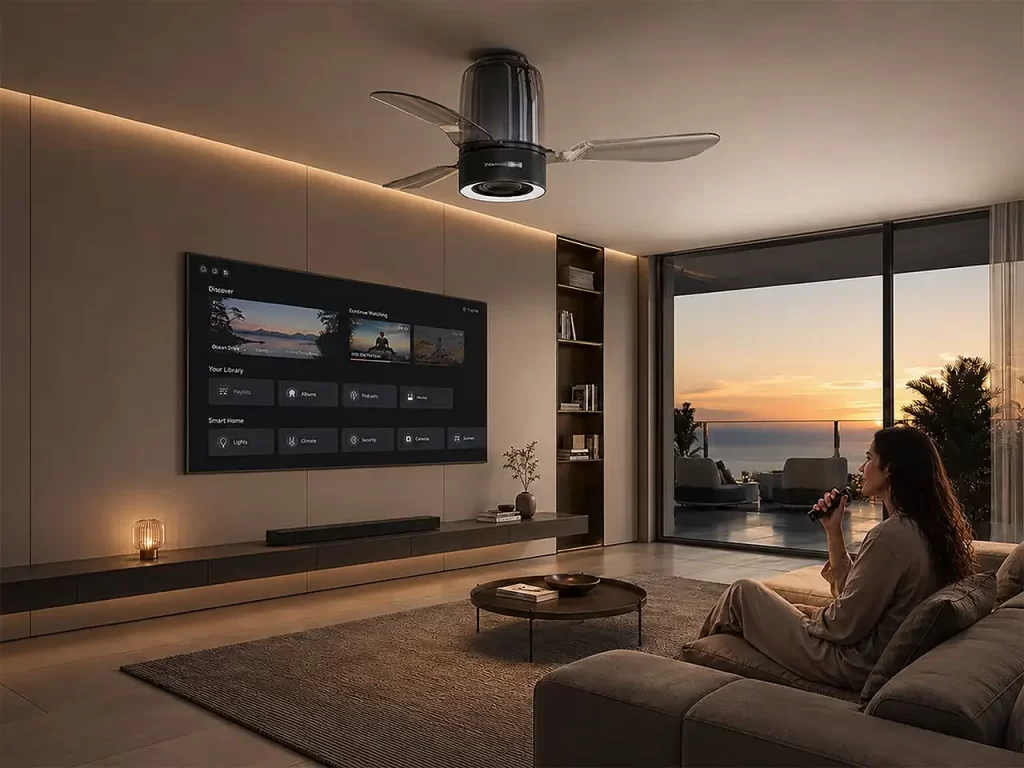
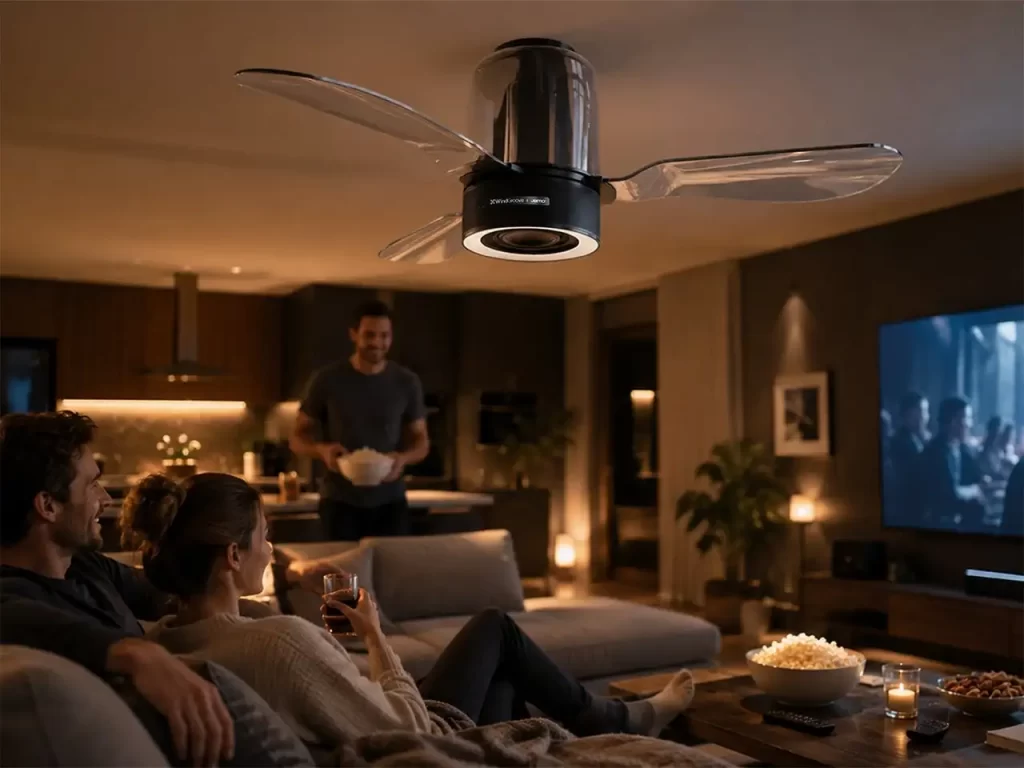
想象一下周五的晚上:你把灯光调暗,房间泛起一层温暖的琥珀色光晕,头顶的风扇几乎感觉不到在转,而流淌出来的音乐,真的就是制作人想让你听到的那个样子。
书架上没有音箱在抢地盘,角落里也没有立式风扇在碍事,更不用开三个 App 去分别控制它们。天花板把一切都搞定了。那种“房间终于对了”的感觉,如果你没亲身体验过,真的很难跟别人解释清楚。
设计师视角的碎碎念:
说实话,做集成产品最怕的就是“为了集成而集成”,最后搞出个四不像。但 AirFi One 让我看到了工业设计的另一种可能:当工程问题(比如振动、声学反射)被足够尊重并解决后,产品形态的边界就被打破了。它不是在堆料,而是在做减法——把地面的杂乱减掉,把空间的纯粹还给用户。这才是高级的设计。
Industrial Design New Species: Reinventing Spatial Experience with Minimalist Design
NINEIDEA: Light comes from above, and so does the wind. Sooner or later, someone will ask the obvious question: Why can’t sound also come from above? For many years, ceiling fans have been quietly adding features to themselves – adding a light, a remote control, and occasionally some smart functions. But to be honest, most of these so-called “light and fan integrations” are just polite upgrades, and people actually don’t have much enthusiasm for such home appliances. It wasn’t until the emergence of AirFi One, a new species of industrial design that reshapes spatial experience with minimalist design, that it truly stepped into the threshold of “living room core experience”.
AirFi One seamlessly integrates Hi-Fi sound, ambient lighting, and air circulation system into a ceiling fixture. What impresses me most is that its audio system has been jointly tuned with Jamo, a veteran Danish audio brand founded in 1968. This instantly boosts the credibility of the product, making it far from being just a gimmicky gadget that tries to do everything but excels in nothing.
Upon hearing the idea of “inserting speakers into ceiling fans”, you might find it a bit absurd. However, after about three seconds, you’ll realize: how much valuable floor space have we wasted just to accommodate these floor-standing speakers and upright fans?
Brand: WindGroove Original Author: SARANG SHETH
The “hellish” challenge of acoustic design
From the perspective of acoustic design, cramming a loudspeaker into a rotating mechanical system is simply a “hellish” challenge. No one dared to tackle it in the past. Why? Because the motor generates vibration, which propagates along the metal casing and mounting components, ultimately being absorbed by the speaker unit. Furthermore, when the fan speed increases, the periodic pressure changes generated by the fan blades cutting through the air directly cause the diaphragm to vibrate, resulting in distorted sound.
What’s even more challenging is that the sound is directed downwards from above, and the ceiling serves as a massive reflecting surface, which is highly susceptible to phase cancellation and comb filtering effects – some frequency bands overlap, while others are directly cancelled out. To achieve clean Hi-Fi sound quality on a mechanically rotating device that is also suspended above a person’s head is undoubtedly an impressive engineering feat.
Design philosophy where technology is integrated into space
The entire design philosophy can be summed up in one sentence: Technology should blend into the space, rather than stand out to make a presence.
To achieve this “dissolution”, they had to work tirelessly on the engineering side. To solve the problems of motor vibration and fan blade pressure pulse, they implemented a very clever DSP (Digital Signal Processing) algorithm that can correct the acoustic defects caused by ceiling reflection and overhead projection in real time.
This is what I consider to be the most elegant solution – making the loudspeaker “invisible” in the building while still filling the sound field. The official total harmonic distortion (THD) is controlled below 1%, which means that what you hear is pure music, not the painful howling of hardware. At the same time, they reduced the motor noise to below 32 decibels, directly cutting off mechanical vibration at the source, which also greatly reduced the burden on the later DSP algorithm.
Centuries-old acoustic tuning
In terms of tuning, WindGroove clearly borrows the “soul” of Jamo. Jamo has adhered to the Scandinavian-style acoustic balance since 1968, and the AirFi One inherits this trait. This 80W three-way system (two 15W mid-high frequency units + one 50W standalone bass unit) is truly designed for Hi-Fi, rather than the “just making it sound” compromise solution commonly seen in integrated home appliances.
The frequency response range is achieved from 45Hz to 20kHz, with rich bass and clear high frequencies. It is willing to seek the tuning of such a well-established audio brand, rather than just randomly stacking cheap speakers. Even if the technology is invisible, when you actually sit down to listen, it must maintain the highest level. The logic behind the decision to integrate an 80W Hi-Fi system tuned by Jamo into a fan is: space comes first, and the hardware itself finds a way to be invisible.
Ultimate parameters and immersive scenarios
Let’s take a look at the hard parameters: the maximum air volume is 4621 CFM, and the noise remains below 32 decibels. This means that you can listen to music while running the fan, and the sound of the fan won’t interfere with the music at all. The fan blades can also be reversed, making it suitable for both winter and summer use.
The lighting design features a dual-zone approach, balancing basic illumination and ambiance.
The main light source in the lower half provides uniform and bright lighting, supporting three color temperature options: warm white (relaxing), natural white (for daily use), and cool white (to refresh). Additionally, it features a stepless dimming feature, allowing you to adjust the brightness to your comfort level, whether you want to enjoy a relaxing drink at night or read or apply makeup in the morning.
Imagine a Friday night: you dim the lights, the room is bathed in a warm amber glow, the fan overhead barely feels like it’s spinning, and the music that flows out is exactly as the producer intended for you to hear it.There are no speakers on the bookshelf competing for space, and no standing fans in the corner getting in the way. There’s no need to open three apps to control them separately. The ceiling takes care of everything. If you haven’t experienced the feeling of “the room finally feels right,” it’s really hard to explain to others.
Random thoughts from a designer’s perspective:
To be honest, the biggest fear in developing integrated products is “integration for the sake of integration”, which can lead to a product that is neither fish nor fowl. However, AirFi One has shown me another possibility in industrial design: when engineering issues (such as vibration and acoustic reflection) are sufficiently respected and addressed, the boundaries of product form are broken. It’s not about piling up materials, but about making a subtraction – removing the clutter on the ground and returning the purity of space to the user. This is advanced design.